Your customers have already decided — before they call you
You probably know the feeling. The phone rings less often than it did 5 years ago. The inquiries that come in are more specific. And when the customer finally gets in touch, they’ve already checked 2-3 alternatives.
It’s not a coincidence. It’s the new reality in B2B sales.
It’s not about gut feeling — the numbers are pretty clear
Dreamdata has analyzed data from hundreds of B2B companies.
81% of B2B buyers already have a preferred supplier before they speak to a salesperson. 8 out of 10 times, it’s the customer who reaches out — not the other way around.
Gartner says the same: buyers spend only 17% of their total buying time in direct contact with suppliers. The rest — over 80% — they spend researching on their own. Google, websites, cases, talking to colleagues in the industry.
67% of B2B buyers prefer a buying experience completely without salesperson contact.
That doesn’t mean the salesperson is redundant. It means the salesperson’s role has changed. The customer doesn’t want a salesperson presenting the product — they’ve already figured that out themselves. They want a salesperson who can confirm their choice, adapt the solution, and remove the final uncertainty.
You can reach the customers — but what happens when they land?
Here’s what makes this urgent: it’s easier than ever to get in front of the right customer. LinkedIn ads, Google, retargeting, industry sites — you can reach an operations manager in a manufacturing company in Herning for a hundred kroner.
That’s fine. You get traffic. People click through to your website.
But what do they meet?
"Contact us for price." A product datasheet in PDF. Maybe a contact form.
So you paid to get the right person through the door — and lost them again because they can’t find what they came for. They wanted to know what’s possible and what it costs. Instead, they got a form and a message that "we’ll get back to you."
The competitor who lets the customer see the options right away? That’s the one they call.
The problem for companies with customized products
If you sell standard products from a catalog, the solution is simple enough: put prices and product info on the website.
But most manufacturing companies don’t make standard products. You make solutions. Ladders in custom dimensions. Platforms for specific installations. Surface treatment according to the customer’s requirements. Products where the price depends on 10-15 variables.
And then the process still looks like this:
- The customer finds your website
- The customer sees "Contact us for price"
- The customer fills out a form
- A salesperson calls back — within 1-2 days, if things go well
- The salesperson asks questions to understand the need
- The customer gets an offer 2-5 days later — often as 3-5 lines and a total
6 steps. 6 places where the customer can drop off.
And the offer they receive in the end? Often an ERP extract with plain price lines. No pictures. No description of what they’re actually buying. Just numbers.
The customer can’t see the difference between you and the competitor. So they choose the cheapest one.
The salesperson is not redundant — but the timing has changed
This is not about replacing the salesperson with a website. Gartner actually shows that B2B buyers who use digital self-service tools in combination with a salesperson are 1.8 times more likely to complete a good purchase.
But the sequence matters.
The customer wants to explore on their own first. Understand what’s possible. See what it costs. And THEN talk to a salesperson who can help them the last 20% of the way.
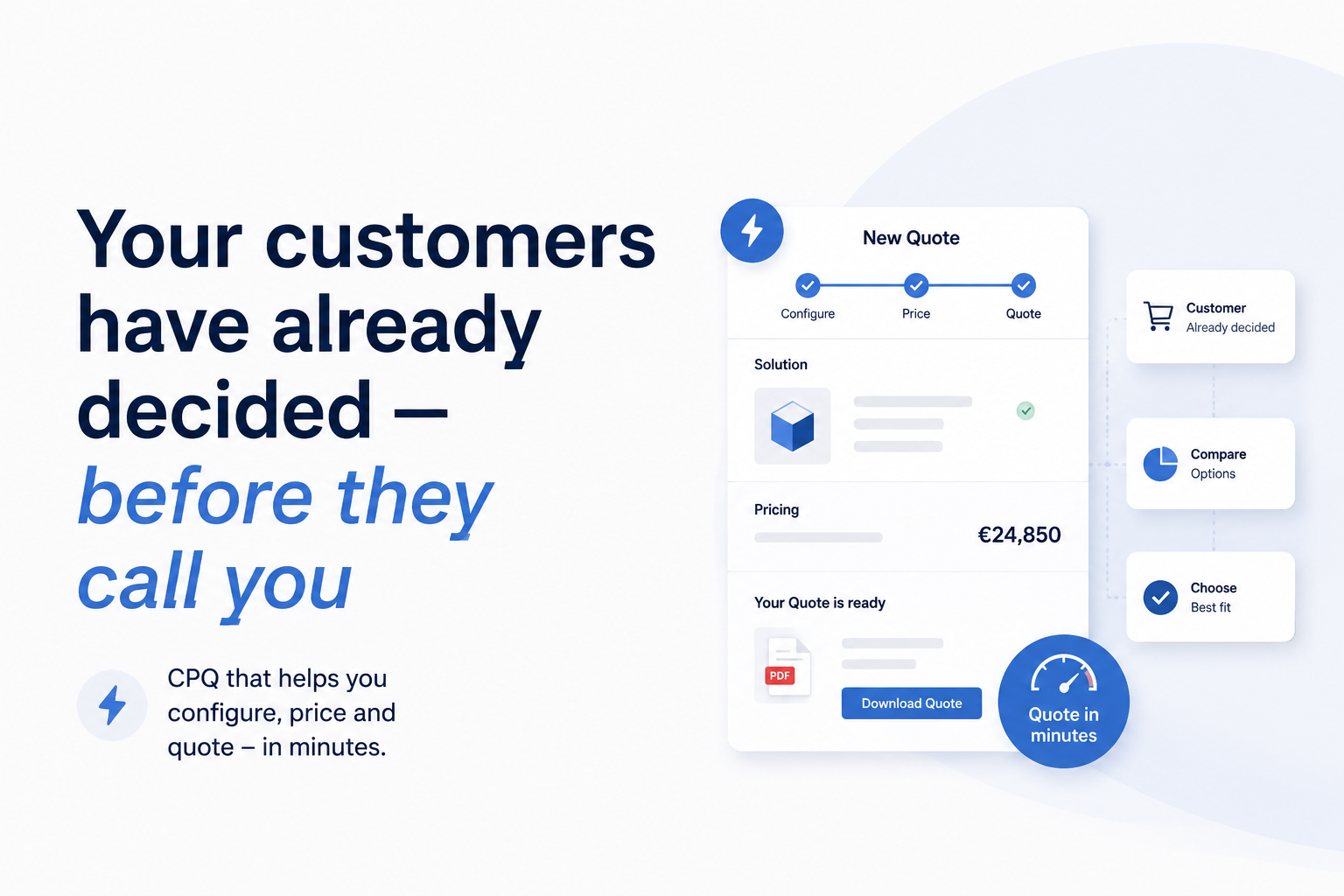
That requires the customer to be able to configure a solution on your website. To see what they’re buying. To get a professional quote — not just a price line — without waiting 3 days.
In practice
For manufacturing companies with configurable products, it’s about moving knowledge out of the salesperson’s head and over to the customer:
- Before: The customer has to call to find out what’s possible.
Now: The customer can explore, configure, and see the result themselves — and calls when they know what they want. - Before: The quote is 3-5 lines and a total.
Now: The quote is a professional document with images, descriptions, and optional add-ons. The customer sees what they’re buying. - Before: The salesperson spends 45 minutes assembling each quote.
Now: The quote is generated automatically, and the salesperson spends time on what they do best — customer contact.
That’s what a product configurator with integrated quote automation does. And that’s exactly what we’ve built at Configo.
The configurator as a lead magnet
But there’s another angle — and it’s the one most people overlook.
A configurator on your website is not just a sales tool. It’s a lead machine.
Think about it: the customer is on your website at 9 PM on a Tuesday evening. He can configure exactly the solution he needs — choose dimensions, accessories, materials. He sees what’s possible. He’s engaged.
And to have the quote sent to him? He enters his name, email, and phone number.
The next morning your salesperson has a lead in their inbox with:
- The customer’s contact information
- The exact configuration the customer created
- A quote that has already been generated
The salesperson isn’t calling a cold contact. They’re calling a customer who has already configured their solution, seen the options, and requested a quote. The conversation starts in a completely different place — it starts with "I can see you’ve been looking at a platform with X and Y. Shall we go through it together?"
That’s the difference between chasing leads and receiving them.
A real-world example: Alulock
Alulock produces custom access solutions in aluminum — ladders, stairs, platforms — where each quote has dozens of variables.
Before, their salespeople spent 42 minutes per quote. With 15 quotes per week, that was over 10 hours weekly on pure quote administration.
After they implemented Configo:
- Quote time dropped from 42 minutes to 8 minutes and 40 seconds — 79% reduction
- 433 hours saved per year, equivalent to 162,375 kr in freed-up salesperson time
- Professional quotes with images and descriptions that show the customer what they’re buying
- Customer response times went from days to the same day
Read the full Alulock case study here →
The real question
Your customers are already researching you. They visit your website, compare you with competitors, and form an opinion — without you knowing it.
What do they meet? A PDF datasheet and "call for price"? Or an experience that lets them understand what you can do, configure a solution, and see what they’re buying?
The supplier who gives the customer answers fastest wins. Not because they’re cheapest — but because they’re easiest to buy from.
At Configo, we help manufacturing companies let their customers configure solutions and receive professional quotes — automatically. Book a demo at configo.dk →
Sources
- Dreamdata: B2B Go-to-Market Benchmarks (2025)
- 6sense: Adapting to the New B2B Buying Journey (2024)
- Gartner: B2B Buyer Survey (2024-2026)
- Gartner: Sales Survey — 67% of B2B Buyers Prefer a Rep-Free Experience (2026)
Ready for the next step?
Get started with Configo — or explore more articles in our knowledge center.